
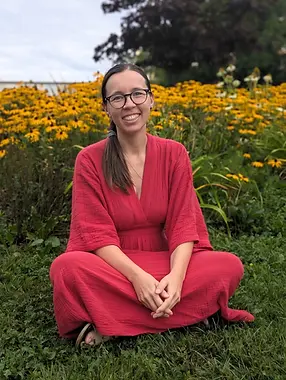
Alžběta Bohme Ryšková, PhD
Bridging the gap between science and everyday life
I am the mother of two multilingual children, a PhD graduate in applied linguistics, and the founder of the Bilingvní děti project. I help parents and professionals discover the beauty of multilingualism, guiding them toward raising successful, confident bilingual children—naturally, clearly, and without unnecessary stress.
In a nutshell
(for those in a hurry):
-
Academic Background: I hold a PhD in Experimental and Applied Linguistics of Romance Languages, and in my dissertation I examined the specifics of children’s multilingual development. I am constantly learning from international experts who work with bilingual children, and I participate—either as an attendee or a presenter—in domestic and international conferences on the topic of child language research.
-
Practical Application: I bring modern international research into our local environment. Through individual consultations, I help mixed-language families find tailored solutions for their everyday realities.
-
My Philosophy: Scientific research and theories are incredibly valuable, but they won’t bring a family peace of mind on their own. My goal is to translate complex academic findings into clear, everyday language that instantly helps those who live the multilingual reality day in and day out.
What I believe in:
I believe that every child has their own unique tempo, and every family deserves an individual approach that respects their unique dynamic. There is no single universal rule or identical path for everyone. That is why in my work, I don’t try to fit families into rigid boxes. Instead, I help them find their own sustainable way to live bilingualism with joy and ease.
What do I do when I'm not working?
When I'm not reading the latest articles on the impact of early bilingualism on neurological pathways, I enjoy spending time with my family, traveling together, playing sports, walking with our four-legged friend, or exercising my brain in a pub quiz. When I want some alone time, I like to play the piano or pick up a good book.
Why I do what I do (for those who love a good story)
When I was expecting my first child, I already held a degree in English and Spanish from the Faculty of Arts. As a proper philologist, I knew that bilingual upbringing was just as natural as monolingual one, and completely harmless to children. So, I had a decent amount of theoretical knowledge. What could possibly go wrong?
Since my husband is a foreigner and we each have a different native language, it was clear from the start that our child would grow up bilingual. The only question was: in which languages, exactly? My husband was lobbying for English—even though his native language is Spanish—arguing that “English is more useful nowadays.” I countered with: “Almost everyone learns English sooner or later anyway.” Our endless linguistic debates were eventually cut short by the future grandmother, who firmly declared: “I want a grandchild who can talk to me in my language.”
And that was that. The strategy of “me in Czech, husband in Spanish, and together a bit of everything” emerged spontaneously, without any grand parental strategy meetings over a flipchart. After our daughter was born, we stuck to the plan religiously. Shortly after her first birthday, her first words arrived. Then more. And more. Her vocabulary grew, simple sentences appeared, and everything looked exactly like the smart child development books described.
Except for one tiny detail. The words were almost exclusively in Czech.
Our daughter clearly understood Spanish. When my husband said something to her, she reacted correctly. But her response? Always in Czech. Completely consistent and unwavering. Like a tiny national revivalist.
The longer this went on, the more nervous my husband became. Gradually, he started speaking Czech to her too. I remember trying to convince him: “Don’t switch to Czech. We want her to know Spanish, too.” But he looked at me in sheer desperation and said a sentence I have heard from parents countless times since: “But I want to be able to communicate with my own child.” I tried to whip out my theoretical university knowledge, telling him that bilingual language acquisition can be a long process, and the most important thing is to persist. But my husband is a pragmatist, and he asked me a question I couldn’t answer: “And how much longer am I supposed to wait?”
Good question. My answer? Absolutely zero. It turned out that my academic knowledge ended exactly where real life with a toddler began.
So, I started buying up books on bilingual upbringing, digging through scientific studies, and looking for answers. By that time, I was already keeping detailed records of my daughter’s vocabulary and language development. With the arrival of my second daughter, I became a total nutcase. What started as simple note-taking turned into full-blown linguistic research. I kept language development diaries, made spreadsheets, and enthusiastically analyzed children’s sentences in a way that normal people would probably find slightly disturbing.
But the more fascinated I became, the more I hit a wall: most high-quality scientific studies were locked behind expensive publisher paywalls. And because my desire for answers was apparently stronger than my common sense, a perfectly logical plan was born: apply for a Ph.D. program and gain (nearly) unlimited access to academic databases.
And so, ten years after graduation, I found myself back at the university—even though at my master’s graduation, I had sincerely sworn I would never step foot on academic soil again! :-D After four years of intensive study and the grueling process of writing my dissertation, I graduated with honors. When I was then faced with the decision of whether to pursue an academic career or put my acquired knowledge into practice, I chose the latter.
When I tell people what I do today, I usually encounter two extremes. People with no experience in bilingualism often say: “What is there to research? Kids just absorb languages like sponges.” On the other hand, parents of multilingual children ask: “If kids absorb languages like sponges, why does mine feel more like a tree stump?”
It was these exact questions that eventually led me to start this project. Because families usually don't need another complicated scientific paper full of jargon. They need empathy, support, practical information, and sometimes just to hear that what they are experiencing is completely normal.
And how did it turn out with our firstborn? Gradually, she began sneakily mixing Spanish words into her Czech sentences with her dad. There were more and more of them, until one day, Spanish took over completely. By the time she was three, she spoke pure Spanish with her father.
Though… those two linguistic worlds still blend together from time to time. Because honestly—when you have two languages at your disposal, why not use both? Especially when a cucaracha is just so much funnier than a regular old cockroach.